
Key Takeaways
- Problem: Historic 19th-century parquet floors often suffer from loose blocks, bitumen adhesive failure, and centuries of ingrained grime.
- Agitation: Using aggressive modern machinery on delicate timber can shatter original tiles, while improper adhesives lead to seasonal ‘lifting’ and movement.
- Solution: A meticulous heritage restoration approach involving block-by-block re-bonding, dust-free sanding with a Bona Flexisand, and nourishing Osmo Hardwax Oil.
The Grandeur of Upminster’s Period Parquet
Upminster is home to an incredible array of period properties, many of which still boast original 19th-century parquet. Whether it’s the classic Herringbone, the intricate Versailles, or the geometric Finger Block, these timber features represent the pinnacle of Victorian and Edwardian craftsmanship. However, maintaining the integrity of these floorboards requires more than a simple sand-and-seal approach; it demands a dedicated heritage restoration strategy.
Over the decades, these floors are subjected to significant structural stress. In the UK, fluctuations in moisture content within the home cause the wood to expand and contract. This often leads to the failure of original bitumen adhesives, resulting in loose, ‘clicking’ blocks that pose a trip hazard and invite further damage. Before any sanding can begin, our tradesmen must ensure every single block is securely bonded to the subfloor.
The Delicate Art of Parquet Sanding
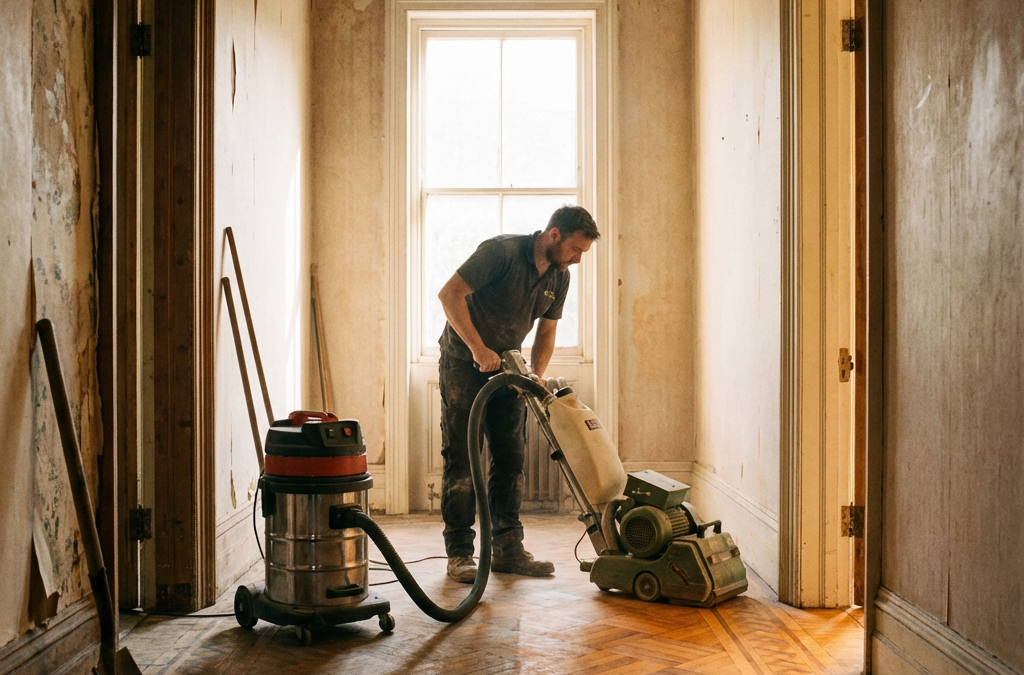
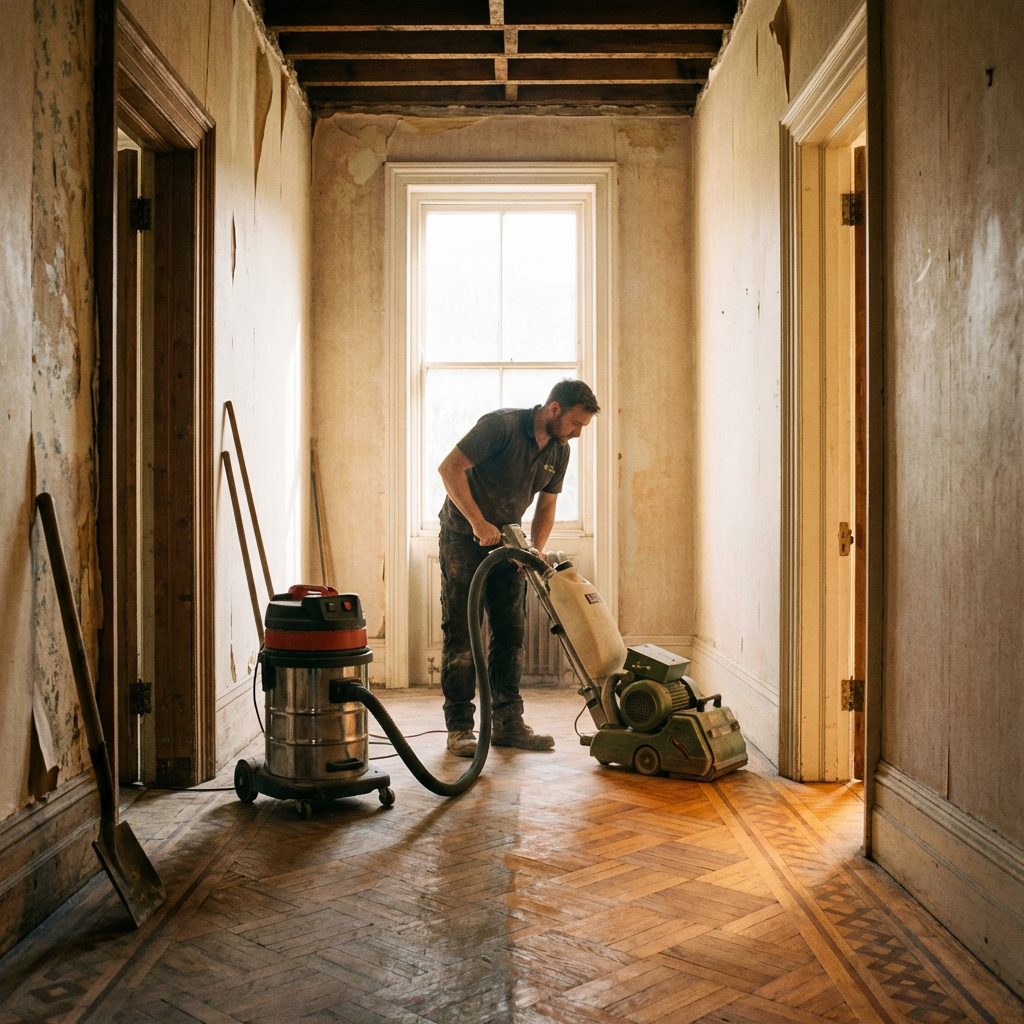
Sanding parquet is inherently more complex than sanding standard planks. Because the grain of the wood runs in multiple directions, a standard belt sander like the Lagler Hummel must be used with extreme precision to avoid cross-grain scratching. For the finest finish, we transition early to the Bona Flexisand, using a multi-disc drive plate to ensure a perfectly flat, planetary-sanded surface.
Pro-Tip: Managing the Grit Sequence
On aged 19th-century oak parquet, we typically start with a 60-grit zirconia abrasive. Starting too coarse (like 24 or 36-grit) on these delicate tiles risks removing too much of the ‘wear layer,’ which is often already thin from previous restorations. By starting with 60-grit, we gently remove surface grime and old finishes while preserving the historical depth of the timber. We then progress to 80 and 100-grit, finishing with a 120-grit mesh screen to eliminate all micro-scratches.
The Perils of Tannin Pull and Grain Raising
When dealing with historic oak, one of the most significant challenges is tannin pull. This occurs when water-based finishes react with the natural tannic acids in the wood, causing dark, splotchy discolouration. To mitigate this, many heritage projects opt for a high-quality hardwax oil. If a water-based finish is requested for its durability, a specific primer from Bona must be used to block the tannins effectively.
Another factor is grain raising. If the wood is not properly conditioned, the application of a liquid finish can cause the fibres to stand up, resulting in a rough texture. Our process includes a precise ‘de-nibbing’ phase between coats to ensure the final surface is as smooth as silk. For those interested in the long-term care of these surfaces, our ultimate wood floor maintenance guide offers essential tips for Upminster homeowners.
Finishing with Osmo Hardwax Oil
For 19th-century parquet, we often recommend Osmo Hardwax Oil. Unlike traditional lacquers that sit on top of the wood, hardwax oil penetrates the timber, nourishing it from within while providing a breathable, water-resistant barrier. This is particularly important for heritage floors, as it allows the wood to breathe and react naturally to changes in the UK environment.
Pro-Tip: The Secret of Water Popping
If the client desires a deeper, more uniform colour, we may employ water popping. By lightly misting the sanded timber with distilled water, we intentionally raise the grain, opening the wood’s pores. When the stain or oil is applied, it is absorbed more deeply, resulting in a rich, multi-dimensional finish that celebrates the antique history of the floor.
Why Choose Professional Tradesmen?
Attempting to restore a period parquet floor as a DIY project often leads to irreversible damage. From gouging the wood with hired sanders to using incorrect adhesives that react with bitumen, the risks are high. Professional tradesmen bring the expertise, specialised machinery, and high-end products required to do the job right. Furthermore, commercial clients should note that all our professional services include clear, transparent invoicing including VAT, making us the ideal partner for both domestic and commercial floorboards restoration projects. For more on the domestic side, see our guide on Victorian pine restoration.
Conclusion: A Legacy Restored
Restoring a 19th-century parquet floor in Upminster is a journey of rediscovery. By combining traditional heritage techniques with modern dust-free technology, we can ensure these beautiful floors continue to grace Upminster’s homes for another century. If your floors are showing their age, consider a professional wood floor restoration to bring back their original brilliance.